
Can heat pumps help with Part O?
Most people know the market is heading towards heat pumps as a solution for heating in the winter. What’s not as well known is the cooling capabilities of modern heat pumps. Some newer models have cooling capabilities built-in, which can assist with Part O compliance.
What is Part O and why are heat pumps relevant?
The current building regulations outline the requirement for overheating mitigation within new-build properties. This is called Part O.
The aim of Part O is to protect the health and welfare of occupants of a building by reducing the occurrence of high indoor temperatures.
In the Government's view, Part O is met by designing and constructing the building to achieve both of the following:
- Limiting unwanted solar gains in summer.
- Providing an adequate means of removing excess heat from the indoor environment.
Limiting solar gain can be achieved through various means, such as:
- Fixed shading devices
- Glazing design
- Building design – for example, the placement of balconies.
- Shading provided by adjacent permanent buildings, structures or landscaping.
If limiting solar gain is proving difficult, excess heat can be removed from the property to still comply with Part O, through ways such as:
- Opening windows
- Ventilation louvres in external walls.
- A mechanical ventilation system.
- A mechanical cooling system
The government is very keen on using passive means as much as possible before adopting any kind of mechanical cooling, in fact it’s a requirement. Passive means are defined as any means of cooling a building which is not mechanical cooling, for example shutters, external blinds, overhangs, awnings, as well as size and orientation of glazing, among other ways.
If all passive means have been exhausted and the property is still not Part O compliant, then mechanical cooling methods such as air conditioning, split systems, and heat pumps can be explored as options.
Air conditioning units can be a solution, but they come with the inconvenience of another system to install, on top of the system for heating and hot water, which leads to more maintenance and energy consumption within the property. Additionally, internal noise pollution can be problematic for air conditioning systems within a property.
Split systems can offer a solution to this problem, but if you’re developing a block of flats or high-rise apartments installing units, and later servicing them, on the exterior of a building can be very challenging. They also don’t look great on the exterior of a building.
Exhaust Air Heat Pumps solve all these problems, as there’s no requirement for any outdoor component and they have active cooling built in.
How can you have a heat pump without any outdoor component?
As with any NIBE Exhaust Air Heat Pump, the heat pump uses waste air from within the property passed through the refrigeration cycle to providing heating and hot water, and in the case of the S735C, also cooling. Here’s a quick explanation of how the S735C works:
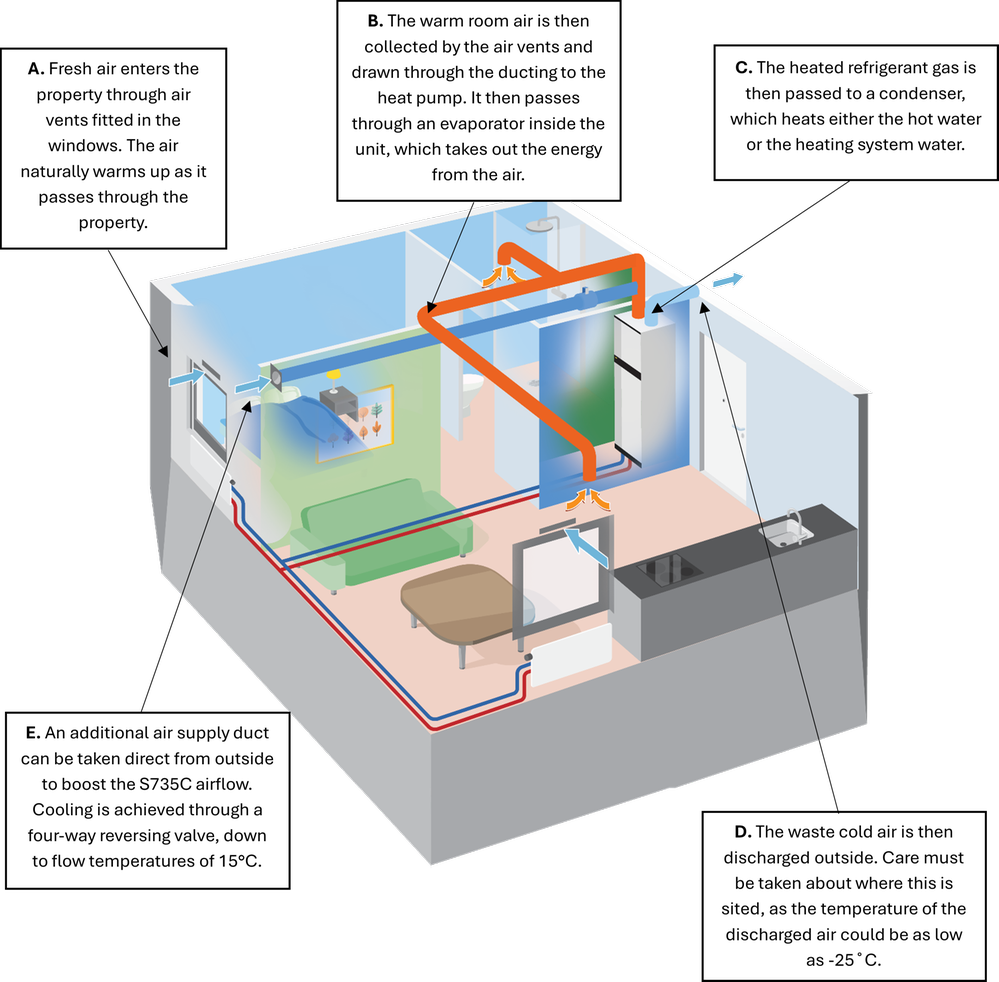
Cooling is made possible through a four-way reversing valve, which reverses the direction of the refrigerant around the circuit and switches the function of the heat exchangers.
In heating mode, the system extracts heat from the air and transfers it to the water.
In cooling mode, the process reverses: the system extracts heat from the indoor air and releases it into the outside air, not the water. The wet system is then provided with cooled water, down to flow temperatures as low as 15°C.
It’s important to note that the S735C is not an air conditioning system, and it doesn’t offer an air-to-air solution. It’s an air-to-water product, and the wet system itself is cooled down. This creates a cooling effect within the property as heat is absorbed by the fan coil units or underfloor and expelled to the outside. Consequently, the S735C contributes towards removing excess heat from within a property, and towards Part O compliance.
Sounds great in theory, but does it actually work?
To support the launch of the S735C we have installed a trial unit in a block of flats in Bracknell, called Royal Winchester House. Royal Winchester House is home to an installation of 337 NIBE F730 Exhaust Air Heat Pumps, the predecessor to the S735C.
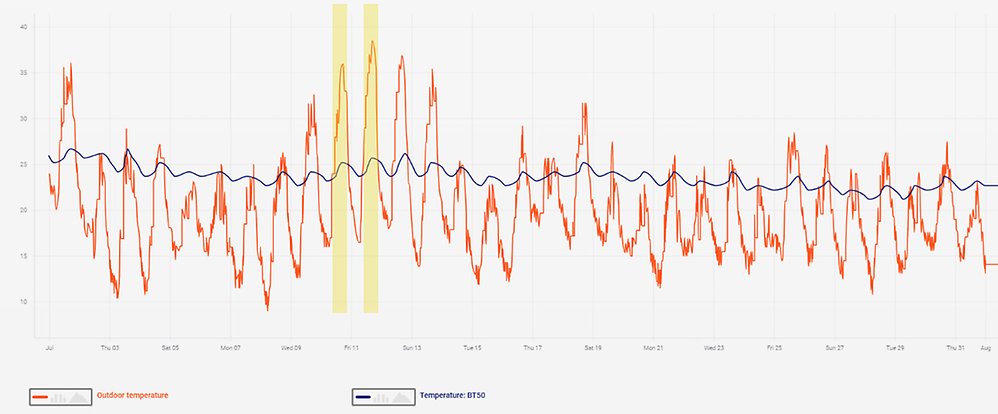
The unit has been operational since November 2024. Data below is taken from July, the hottest month of 2025.
Key moments
06:00 July 10th – outdoor temperature of 16°C, indoor temperature of 23.2°C
17:00 July 10th – outdoor temperature of 36°C, indoor temperature of 25.2°C
06:00 July 11th – outdoor temperature of 16.5°C, indoor temperature of 23.7°C
16:00 July 11th – outdoor temperature of 38.5°C, indoor temperature of 25.7°C
Despite outdoor temperature swings of 20°C+ across multiple days, the S735C can maintain an indoor temperature within a 2°C range. The flat in question uses underfloor heating as an emitter and still achieves respectable results. If paired with fan coil units, the cooling effect would be even stronger.
The results demonstrate the units capability, even during large temperature fluctuations.

Experience Sustainable Living First Hand at NIBE’s New Exhaust Air Show Apartment
We’re excited to invite you to our new show apartment at Royal Winchester House in Bracknell. This modern space features our latest innovation, the S735C Exhaust Air Heat Pump, in action. The unit provides heating, cooling, hot water, and ventilation - delivering the ultimate indoor comfort and energy efficiency.
Book a viewing